
Six Minutes or Nine: What Investigators Said About the Road Camp 12 Fire
Two days after the Berrydale fire, a coroner's jury blamed three prisoners who died in it and found no neglect by the guards. The newspaper reports, official records and later accounts preserved since then do not all agree with one another.
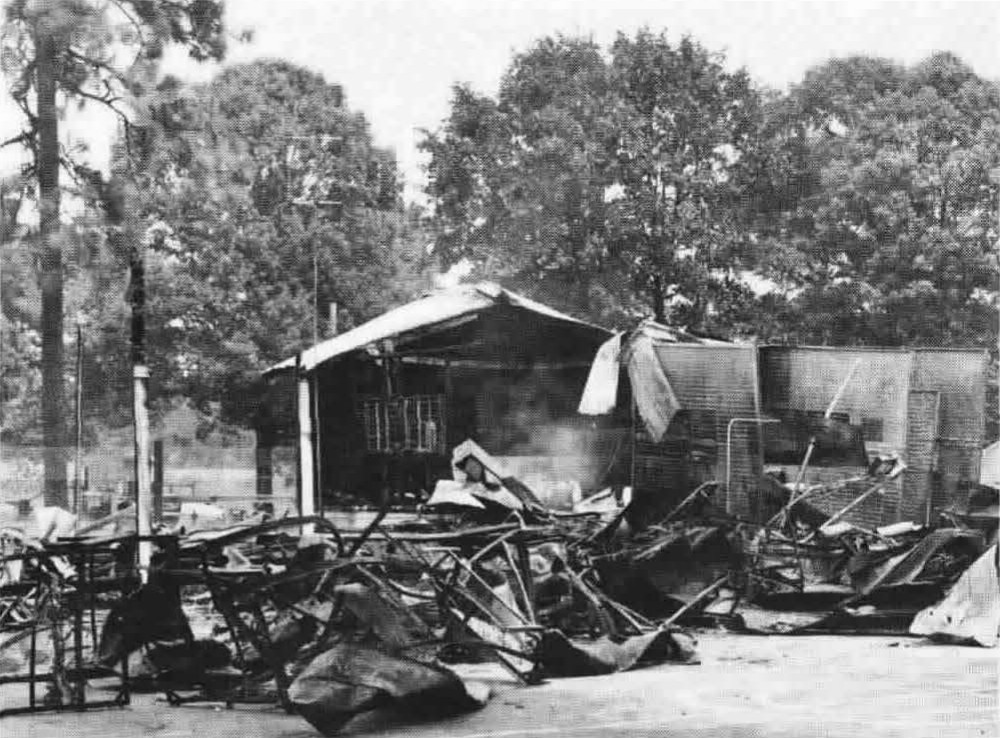
On the morning after the fire at State Prison Road Camp 12, the first explanation came from the prison system itself. The Associated Press quoted assistant warden G. C. Mayne Jr.: fighting prisoners had broken a gas line and smashed a fluorescent lamp, and a spark from the lamp set off the blaze. [1]
Read the original report on the Road Camp 12 fire
The record
Within a day, that account had changed. On Monday, July 17, 1967, a coroner's jury heard surviving prisoners testify that the fire was set on purpose. On Tuesday the jury named three men responsible. All three had died inside the barracks.
Our earlier account of the fire noted that neither an inquest record nor survivor testimony was available to that reporting. Newspaper coverage of the inquest has since been preserved in Crypt of Echoes, along with later official and institutional records. This story examines what investigators said and how their explanations shifted. It also looks at what the record still leaves open.
The first account
The first AP report ran under the label "Racial Clash." It said the camp had been integrated the previous week. Pasco Rowells, the State Highway Department foreman who supervised the men on road crews, told reporters the fight had started between a Black prisoner and a white prisoner. He said there had been reports of racial trouble among the 35 Black and 16 white men held there. [1]
Mayne said the guards ran for their weapons when the fighting broke out. Chief Deputy Harwell Enginger confirmed the gas-line explanation. The first alarm was recorded at 10:42 p.m. Guard Cocker Nelson said the World War II-style barracks was destroyed in eight minutes. [1]
The inquest
The inquest opened Monday, July 17, before County Judge Mahlon McCall at the Santa Rosa County Courthouse in Milton. The AP reported that 22 bodies in olive drab bags lay outside the old county jail, awaiting identification. On the table were the prison files of all 51 men who had been locked in the barracks. [2]
Surviving prisoners testified under shotgun guard. Some came to court shirtless, others in T-shirts marked by ash and smoke. [2] They described a disturbance that grew into destruction. A television was smashed, and then the fluorescent lights. One prisoner told the AP that a guard had asked them to put out the fire but said he did not have the key. [3]
The prisoner witnesses named three men they said had set the fire: Joseph Earl Wynder, Thomas E. Ard and Earl Evans, all from the Pensacola area. They said the three lit newspapers and toilet tissue. [2] Another AP report described testimony that the men intended to make the building unusable. [4] One surname needs caution: the archive notes that other sources give a different surname for the man printed here as Earl Evans. [3]
Guard A. O. Lovett gave a different account of how it began. He said resentment started when a pornographic book was confiscated from Ard. [2]
The key
Every account turns on the door.
Lovett testified that when the disturbance broke out, he threw the keys over a high barbed-wire fence to guard Richard E. Cobb. Cobb used them to open the prison arsenal. Lovett said they needed longer guns. On returning to the fire, he made repeated attempts to open the door, struggling to see in the heat. [2]
Prisoners testified that about six minutes passed between the start of the fire and the moment Lovett unlocked the barred cage door and the solid wooden door behind it. [2] Inside, the men had nowhere to go. Nineteen bodies were found in the shower room, where the men had apparently sought refuge from the heat. Sixteen were found beneath a barred window. [3]
Lovett, 49, had been a prison guard for a year. Once the door was open, he went into the burning building and pushed five frightened men out ahead of him. [1][3] Survivors used axes from a truck to cut a hole in the wall and pull seven more men through. [4]
A later federal training publication puts the delay at about nine minutes, not six. It also says why. According to the U.S. Department of Justice's National Institute of Corrections, the same key that opened the gun cabinet also opened the building's single exit. [6]
The verdict
The coroner's jury reached its verdict Tuesday, after two days. It attributed the deaths to Ard, Wynder and Evans. According to UPI, testimony suggested the three had set the fire to force the state to replace the old barracks with better quarters. [5]
The jury also made two broader findings. It said it found "no signs of racial violence" among the prisoners. It found "no neglect on the part of the guards or prison officials." [5]
The surviving newspaper reports do not say whether jurors considered the single-key arrangement. Those reports are what survive here. Crypt of Echoes holds no transcript of the inquest or copy of the jury's written finding. The findings are known only as reported by the press.
Inspected weeks before
Two other facts surfaced during the inquest week. On June 6, about six weeks before the fire, state inspector R. B. Gramling had rated Camp 12 "good" to "very good" in every category. His report described the old wooden prison as well maintained and its buildings and equipment as being in good shape. [3]
Louie Wainwright, director of the State Corrections Division, said the system had already planned to close Camp 12. [3][4] He did not say why. The AP noted that a similar camp about 20 miles away, Camp 9, had closed on June 30, reportedly because of high maintenance costs, after an official prison commission criticized its conditions. [4]
What followed
Several investigations followed: the state fire marshal's office, private investigators assigned by Gov. Claude Kirk, and a formal inquiry by the state attorney's office. Kirk also ordered safety checks at 13 other road camps with similar buildings. [3]
The fire's effects reached beyond Florida. In Atlanta, Georgia's fire commissioner sent inspectors into that state's prison work camps the same week. A legislative committee had already identified dangerous conditions at several Georgia camps, and the commissioner cited the Florida fire as a reason to move urgently. [7]
On September 7, 1967, state fire officials set a wooden road-prison barracks alight at Live Oak to simulate the conditions at Jay. An AP wirephoto caption says they put out the fire after three minutes so they could study the results. [8] The archive holds the photograph, not a report on what the test found.
The death toll also changed. Early reports counted 37 dead. The archive records a final total of 38 after Jimmy Copeland died on July 19. [9] Florida's handwritten prison death log records the fire deaths under the label "RP 32." The archive has not yet established how that label relates to the camp the newspapers called Road Camp 12. [10]
Nearly two years later, on May 16, 1969, the Florida Legislature commended Captain Calvin E. Ellison of the Milton Fire Department. A concurrent resolution recorded that observers had seen him give mouth-to-mouth resuscitation and other emergency aid that night. It said "it is possible that his efforts preserved life." [11]
What the record leaves open
The preserved record supports several firm points. The barracks was locked. The guard at the door did not have the key while the fire began. Prisoners testified that men among them set the fire deliberately, and the coroner's jury accepted that testimony within two days.
It leaves other questions open. The prison system's first explanation, an accidental spark from a broken gas line, was replaced by testimony of a deliberate plot. The first AP report described a racial clash, but the jury found no racial violence. The delay in opening the door is given as six minutes in one account and nine in another. The jury cleared prison officials; the surviving newspaper reports do not say whether jurors considered the arrangement that tied the arsenal and the only exit to a single key.
The three men the jury blamed could not answer the allegations. They died in the fire.
About the reporting
This account relies on contemporary AP and UPI reports as printed in the Big Spring Daily Herald (Texas) and the Playground Daily News (Fort Walton Beach). It also uses a Florida Senate Journal resolution, a National Institute of Corrections training publication, an AP wirephoto caption, and Florida's prison death logs. All are preserved in Crypt of Echoes. Newspaper reports of testimony and of the jury's findings are reported claims, not court records. No inquest transcript or written verdict was available. Racial descriptions are summarized from how the 1967 reports described the prisoners. Names are given as printed; where sources disagree, we say so. Key accounts of the delay and jury findings were compared with source scans during publication review; this does not constitute an independent human proofread of every archive transcription.
Sources & archive records
- Pen Fire Kills 37 - Big Spring Daily Herald, July 17, 1967, page 1
Big Spring Daily Herald, July 17, 1967, p. 1, Pen Fire Kills 37.
- Cons Testify Cellmates Set Deadly Blaze — Big Spring Daily Herald, July 18, 1967, page 12
Big Spring Daily Herald, July 18, 1967, p. 12, “Cons Testify Cellmates Set Deadly Blaze,” Associated Press.
- Convicts, Guards Tell Of Fatal Prison Fire
Playground Daily News, Wednesday morning, July 19, 1967, page 10.
- Prison Inferno Plotted, Fire Survivors Testify
Playground Daily News, Tuesday, July 18, 1967, front page and continuation identified as page 2.
- Jury Charges Prison Fire Set By 3 Convicts
Playground Daily News, July 19, 1967, page 10 (placement linked by overlap with the preceding article).
- Fire Safety in Correctional Facilities — Berrydale fire account
U.S. Department of Justice, National Institute of Corrections. Fire Safety in Correctional Facilities — Berrydale fire account. Publication date not verified. Printed page 5 (PDF page 16), Berrydale, Florida — July 1967.
- Georgia Begins Prison Camp Investigations
Playground Daily News, Wednesday morning, July 19, 1967, page 10 (identified by overlapping page photographs).
- Live Oak: investigators recreate a barracks fire
Associated Press wirephoto caption on front. September 7, 1967 test; September 8 notation on reverse. Seller historicimages-store, eBay item 356249447824.
- Berrydale: the aftermath of the Road Camp 12 fire
UPI credit on reverse. July 17, 1967 caption; fire occurred July 16. Seller soxphotos, eBay item 365960145559.
- Florida State Prison Death Logs, 1960–1972
Florida State Prison Death Logs, 1960–1972. State Archives of Florida / Florida Memory. https://www.floridamemory.com/items/show/350815
- Florida Senate Journal — commendation for Captain Calvin E. Ellison, Road Camp 12 fire
Florida Senate. Florida Senate Journal — commendation for Captain Calvin E. Ellison, Road Camp 12 fire. May 16, 1969. Printed page 385 (PDF page 6), HCR 1954.
Keep reading
View all
"Averse to Flatter Treason": Mobile's Offer to Trade Taxes for Peace
In November 1810, with an armed American expedition preparing to march on Spanish Mobile, the governor offered through a local merchant to scrap the duties that had angered settlers upriver. A federal judge's private reply shows why he would not use the offer as a bargaining chip.
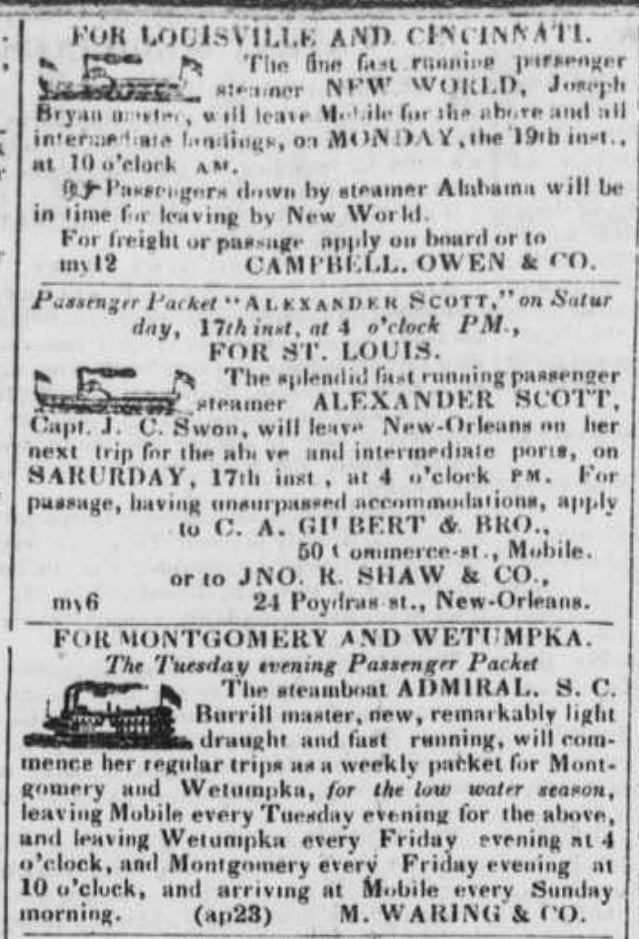
Leaving Mobile, May 1845: Three Steamboats and the Promises They Made
A single newspaper column of passenger notices shows how Mobile travelled in 1845: by published schedule, by the river's water level, and through agents on Commerce Street.
Road Camp 12: The Berrydale Fire That Killed 38 Prisoners
On a Sunday night in 1967, fire swept through a wooden prison barracks in the Florida Panhandle. Fifty-one men were inside. Only thirteen survived.