
Road Camp 12: Now You Can Examine the Berrydale Fire Evidence Yourself
Thirty-eight men died in a locked prison barracks near Berrydale in 1967. We've built an interactive investigation around the surviving records — a document workspace, an index of everyone named, and the questions still open — so you don't have to take our word for any of it.
On the night of July 16, 1967, a fire broke out in a locked wooden barracks at Florida Road Prison Camp 12, in the panhandle woods near Berrydale. Thirty-eight men inside did not get out. Fifty-nine years later, the state's own files about that night — the investigation, the roster of the dead, the quiet changes made afterward to how keys were handled — survive in the public record, scattered and hard to read. We gathered them, and then we did something a printed article cannot: we built a place where you can examine the evidence yourself.
Why an interactive investigation, and not just an article
We have already published a long account of what the Berrydale records reveal — the locked exit, the key that went to the armory, the three accused men, the wooden camps the state had been warned about. That reporting stands. But reporting is, unavoidably, a summary. It asks you to trust the writer's reading of the documents.
The interactive investigation is the opposite bargain. It puts the documents in front of you and invites you to check the summary against the source. You can turn a preserved photograph over, zoom into its caption, and follow the thread from the image to the record that explains it. You can browse an index of every person the files name. You can read the questions we have not been able to answer and see exactly which document each one comes from. It is built on the premise that a reader who can inspect the evidence is worth more than a reader who can only believe it. [1]
A finding is not the end of an investigation. It's a place to start reading.
The document workspace
At the center of the investigation is a document workspace built around one of the most misunderstood images in the record: a photograph of a controlled barracks fire at Live Oak, conducted on September 7, 1967 — nearly two months after Berrydale. Investigators set that fire deliberately, to study how the camps burned. It is not a photograph of the Berrydale fire, and it has circulated as if it were. [2]
The workspace lets you examine the original image with its watermark and printed caption intact, flip to the reverse, zoom in, and select the highlighted caption to connect the photograph to the record that documents it. The point of preserving the watermark and the original caption is to make misattribution impossible: you can see for yourself what the image is and what it is not. An archive that quietly crops away a watermark is asking for trust. One that leaves it on is offering proof.
Fifty-one men, named
The corrections report places fifty-one prisoners in the barracks that night: thirty-eight who died and thirteen who survived. For decades those men were a number in a headline. The investigation preserves them as individuals — an index of every person the files name, with separate entries for the victims, the survivors, the officials, the relatives, the investigators and the responders. [3]
This is the part of the project that matters most and photographs least. A number cannot be grieved. A name can. The index is why the early confusion over whether 37 or 38 men died — a confusion that came from counting different moments in the aftermath, as two men died after the initial escape and one died three days later — resolves into a roster of specific human beings rather than a statistic that drifts by one.
The questions we could not close
An honest investigation publishes its loose ends. The interactive page gathers the ones we could not resolve, each tied to the document that raises it.
One of the death-log descriptions carries a notation — 'RP 32' — whose relationship to the camp the newspapers called Road Camp 12 remains unreconciled. Camp identifiers in Florida's prison system of the 1960s were not always consistent across institutional records, and until the original paperwork is matched, the discrepancy stays open. [4]
The archive's own research guide lists the appendices, family correspondence, rescue records, identification and burial documents, and keys-and-safety implementation files that the released records reference but do not contain. And a preserved request ledger tracks the public-records routes we have pursued — sixteen agency and reference contacts, forty-six dated events — so that the status of the investigation is itself part of the public record, not a private claim. [5]
Three accused men and a consequential name
The investigation that followed the fire did not end with the officials cleared. It also moved against individuals, and the records name three men accused in connection with the fire. Here the documents demand unusual care from a reader, because the files contain a name conflict serious enough that getting it wrong would be its own injustice — the kind of discrepancy where a single shared or similar name can attach an accusation to the wrong person across six decades.
The interactive investigation preserves the accusation and the conflict together, rather than resolving it silently in either direction. That is the responsible way to publish a sixty-year-old criminal allegation drawn from incomplete institutional records: show exactly what the document says, flag exactly where the identification is uncertain, and let no reader walk away believing the archive has confirmed something it has not. An allegation in a charging document is not a finding of guilt, and the record says so plainly.
Wooden camps and written warnings
The most damning material in the Berrydale record is not about the night of the fire at all. It is about the years before it. Florida's road-prison system of the 1960s housed men in wooden barracks, and the files show that the danger of those structures had been raised in writing before thirty-eight men died inside one. A warning that goes unheeded is a different kind of document from a tragedy that could not be foreseen, and the record contains the former.
After Berrydale, the state acted — not only by changing the key procedure at the prisoners' exit, but by studying the problem directly. The investigation preserves the documentation of the wooden camps, the warnings about them, and the costs and decisions around closing or replacing them. Read in sequence, these files trace an institution that knew, was told, and moved only after the worst had happened. The interactive view lets a reader assemble that sequence from the primary documents, each one tied to its source, rather than taking the sequence on faith from a summary.
The families, and the people doing the work
Among the most affecting documents in the record are the ones written by families — a relative seeking a body, another seeking answers the state was slow to provide. These letters are not investigative findings. They are the human weight the findings sit on top of, and an archive that preserved only the official reports would be preserving only half the truth of what happened.
The record also keeps the people who responded: the investigators, the officers, and the responders whose actions that night are documented, including a commendation that supplies another route into the rescue record. Every one of them is an entry in the people index, named and placed, so that the night is remembered not as an abstraction but as something specific human beings endured, caused, survived and tried to answer for. The interactive investigation is built to hold all of those roles at once — victims, survivors, officials, families, investigators, responders — because the fire was all of them, not just the number in the headline.
What the records already settle
The interactive view is not only a list of open questions. It also makes legible what the documents do establish. In the weeks after the fire, Florida officials cleared the prison's officials of wrongdoing — and then changed the rules so that the officer at the prisoners' exit would keep a key even when another officer left for weapons. A system does not rewrite its key procedures over a fire it believes was handled correctly. The change is in the record, and it speaks for itself.
The files also document that the state had been warned, in writing, about the danger of its wooden camps before Berrydale, and that after the fire it conducted the Live Oak test specifically to study how such a barracks burned. Read together, those facts describe an institution that understood the risk, was told about it, and acted decisively only after thirty-eight men were dead. The investigation lets you assemble that reading from the primary documents rather than accepting it from us.
How to use it
Start at the top and enter the investigation. Examine the document workspace — turn the photograph, read its caption, follow it to its record. Move to the index and read the names. Open the questions and expand each one to see the document behind it. Every claim links to a preserved source, and every source links to its full record, with provenance and citation. [1]
If you recognize a name, remember a detail, or hold a document — a letter, a photograph, a memory passed down — the record is built to receive it. Investigations like this one close not when a writer decides they are finished but when enough people who were there, or whose families were there, add what only they can. The page tells you which records we are still pursuing and how to reach us.
Explore it at cryptofechoes.com/investigations/road-camp-12-investigation.
The limits of this account
An interactive investigation can be more honest than an article precisely because it can show its own boundaries. The Berrydale record, as it stands, is incomplete in ways the page does not hide. The released state files reference appendices, family correspondence, rescue records, and identification and burial documents that were not produced with them. Some of those documents may still sit in a box in a state archive; some may be lost. Until they surface, parts of the night remain undocumented, and the investigation says so rather than filling the gaps with inference.
There are also the ordinary frictions of fifty-nine-year-old institutional records: inconsistent camp identifiers, handwriting that resists transcription, names that appear in one document and never again. The investigation marks these uncertainties in place. A reader will encounter sentences that end in a question rather than a conclusion, and that is by design. The alternative — a smooth narrative that papers over every gap — would read better and mislead worse.
What the investigation does not do is tell you what to feel about any of it. It assembles the evidence, flags what is missing, preserves the names, and leaves the judgment to you. The documents establish that thirty-eight men died behind a locked door, that the state had been warned about such doors, and that it changed its procedures afterward. What those facts add up to — negligence, tragedy, or both — is a conclusion the record supports but does not force. That is the reader's to draw, with the originals in reach.
Why this is the right way to tell it
There is a reason to build an interactive investigation around a fire from 1967 rather than simply write the article and move on. The people who could correct the record are getting older. The documents that could fill its gaps are scattered across state archives, and some may already be lost. And the version of events that hardens into 'what everyone knows' is almost always the one that was easiest to summarize, not the one that was truest.
An investigation you can examine resists that hardening. It keeps the evidence in reach, marks what is still missing, and leaves the door open for the people who can finish it. Thirty-eight men died behind a locked door that the state decided, afterward, to handle differently. The least the record can do is stay open.
It is also, bluntly, a model for how a small newsroom can do accountability work on a story this old and this large. We cannot re-interview a prison system that no longer exists in that form, or compel documents a court sealed decades ago. What we can do is gather what survives, present it honestly, mark its gaps, and build the thing so that the next person who knows something — a descendant, a retired officer, an archivist who recognizes a box number — can add it. That is not a substitute for the reporting. It is the reporting, conducted in the open, with the reader invited in rather than asked to trust. For a fire the state investigated and then largely filed away, an investigation that refuses to close may be the only fitting kind.
Sources & archive records
- Road Camp 12 (Berrydale) — the interactive investigation
Document workspace, people index, and open questions, each linking its preserved source.
- Live Oak controlled fire test — September 7, 1967 (not the Berrydale fire)
Preserved photograph and caption of the later controlled test; watermark retained.
- Death-log record with the 'RP 32' notation
The camp-identifier discrepancy that remains unresolved.
- Records-request ledger — 16 routes, 46 dated events
Tracks the public-records requests pursued for the investigation as of October 2026.
Keep reading
View all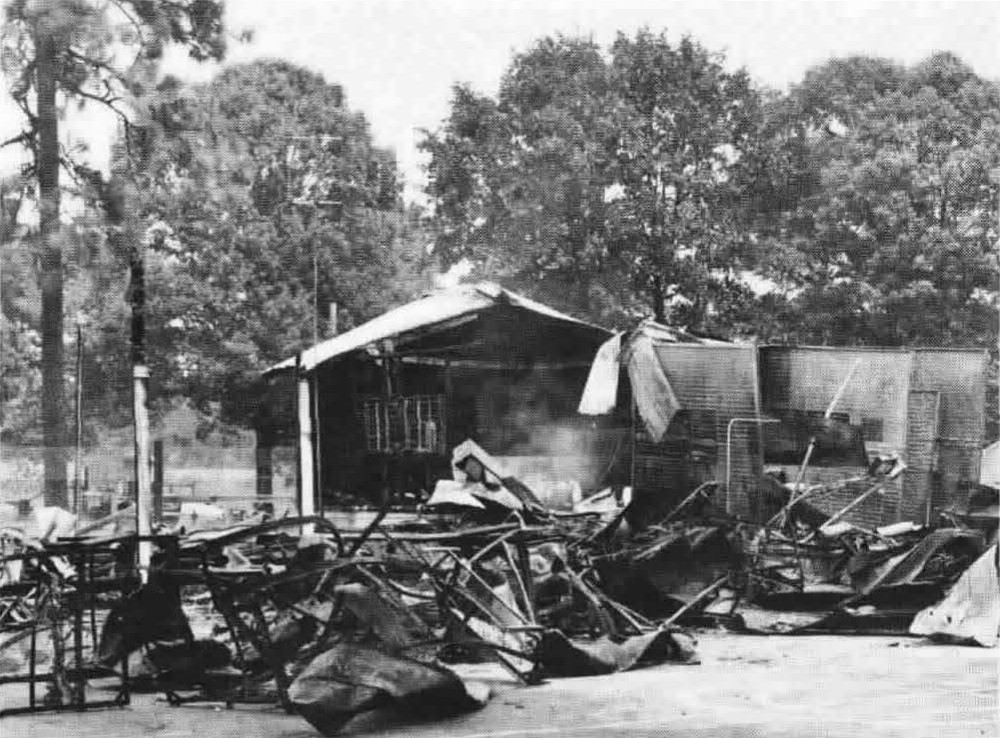
Berrydale: What Investigators Said About the Road Camp 12 Fire
Two days after the Berrydale fire, a coroner's jury blamed three prisoners who died in it and found no neglect by the guards. The newspaper reports, official records and later accounts preserved since then do not all agree with one another.
Road Camp 12: The Berrydale Fire That Killed 38 Prisoners
On a Sunday night in 1967, fire swept through a wooden prison barracks in the Florida Panhandle. Fifty-one men were inside. Only thirteen survived.
Berrydale’s Locked Barracks: What the Records Reveal About the Fire That Killed 38
Newly recovered state files name the dead, trace changes to keys and wooden camps, and preserve families’ unanswered questions. They also point directly to the evidence still missing from the public record.