
Road Camp 12: The Berrydale Fire That Killed 38 Prisoners
On a Sunday night in 1967, fire swept through a wooden prison barracks in the Florida Panhandle. Fifty-one men were inside. Only thirteen survived.
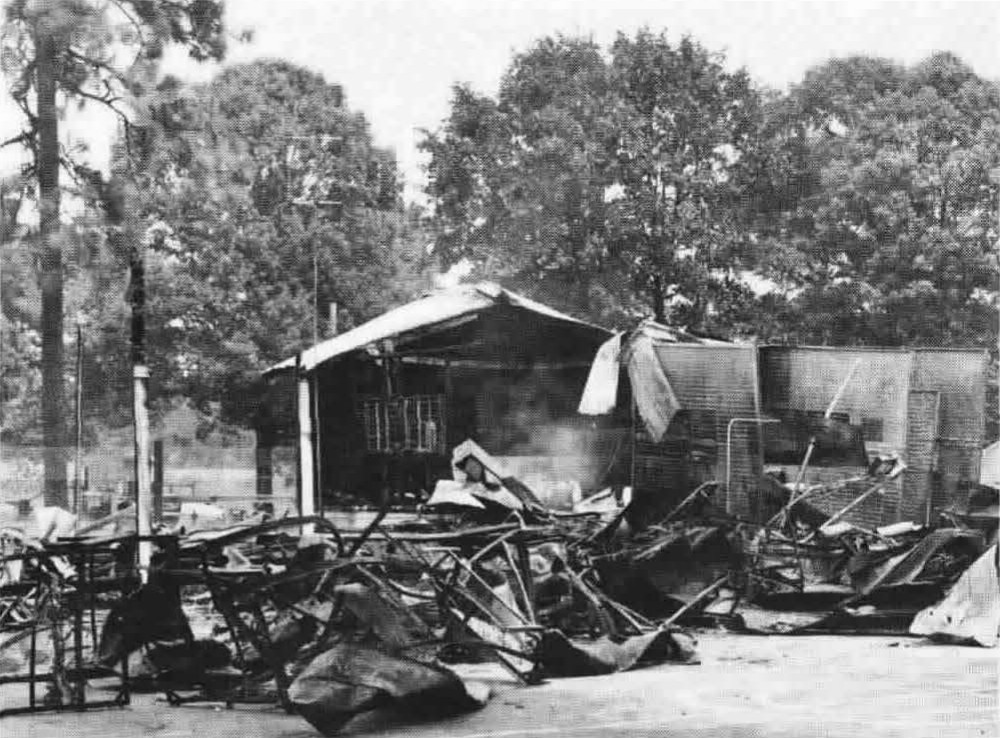
Around 9:30 on a Sunday night, prison guard G. C. Nelson heard a commotion at the Berrydale camp and ran toward the barracks. He tried to quiet the men inside. Before long, he would be looking at flames coming through the windows. It was July 16, 1967. Fifty-one prisoners were housed in the wooden building; thirty-eight would die. [2] [1]
Follow-up: Six Minutes or Nine — the inquest reports and later investigation
Trouble inside the barracks
Road Camp 12 stood in Berrydale, in the Florida Panhandle. The prisoners slept in a single-story wooden barracks. A metal security enclosure placed a guard inside the compound. In a newspaper interview after the fire, Nelson described a fight between two prisoners followed by a disturbance the guards struggled to control. [1] [2]
Nelson said guard A. O. Lovett was at the security enclosure, trying to settle the men down. Nelson went back toward the office to call for help. When he looked toward the compound a short time later, fire was coming through its windows. [2]
The National Fire Protection Association’s later account describes another crucial movement during the disturbance: one guard handed his keys to another, who went to an arms cabinet in a separate office building. NFPA reported that inmates set the barracks on fire while that guard was away. The short report does not identify who lit it or explain the evidence behind that conclusion. [1]
The keys were in another building
Inside the barracks, a large window fan drew heat and smoke through the building. The fire spread quickly. The guard who remained did not have the keys needed to release the prisoners, according to NFPA. [1]
The men’s way out depended on the return of the other guard. By the time he came back and the doors were opened, the report says, thirty-five prisoners had already died. Sixteen made it out of the building. Three of those men later died. [1]
The numbers leave thirteen survivors from the fifty-one men housed there. They also reveal the scale of what happened before the doors opened: most of the prisoners never escaped the barracks. [1]
A call for help that would not go through
Outside, Nelson faced a second failure. He told newspaper reporter Bill Dingwall that he ran to the office to telephone the fire department, but the phone was dead. He believed the flames had burned the electrical system around the barracks. A neighbor’s telephone was eventually used to summon fire units from Whiting Field, Milton and nearby Jay. [2]
Nelson’s interview gives a glimpse of the desperate effort to get men clear of the fire. He described calling to prisoners through an open door and seeing some emerge while others could not. “Some could walk; others couldn’t,” he told Dingwall. Two men, he said, crawled out only to die a short distance away. [2]
Nelson moved those who could walk into a group about thirty yards from the compound. He kept watch over them with a shotgun and a pistol. Men who had escaped a burning prison were still prisoners. [2]
Thirty-eight lives
Photographs of the aftermath show the barracks reduced to wreckage. One newspaper caption describes a search through the ashes for more victims. The photograph later printed in Fire Journal shows the metal guard enclosure amid the remains of the wooden building. [2] [1]
A newspaper clipping headed “Death List” reported thirty-seven dead and printed their names. The later NFPA review put the total at thirty-eight, accounting for thirty-five deaths before the doors opened and three among those who escaped. The surviving clippings do not establish the full sequence of updates to that toll. [2] [1]
In its review of 1967, NFPA ranked Berrydale as the deadliest fire in the United States and Canada that year. A wooden prison barracks in the Florida Panhandle had become the site of the year’s greatest fire loss of life across the two countries. [1]
The story turns on a brutal detail: at the moment fire spread through a building holding fifty-one men, the guard who remained could not unlock their way out. Whatever happened in the disturbance that preceded it, thirty-eight men did not survive the night’s fire and its aftermath. [1]
About the reporting
This account draws on the May 1968 Fire Journal review and four newspaper clippings preserved as original files in Crypt of Echoes. Nelson’s interview describes an open door; NFPA describes the earlier delay in unlocking the building. The available records do not establish exactly how every part of those accounts fits together. The cropped newspaper files lack a masthead and issue date, and their publisher has not been verified. This initial article did not include inquest coverage or survivor testimony. Our October 9 follow-up examines the newly located newspaper accounts of that testimony and the jury’s findings. Readers can examine both archived sources below. [1] [2]
Sources & archive records
- The Major Fires of 1967 — Berrydale prison barracks
Fire Journal 62, no. 3 (May 1968), pp. 5–7; “Prison Barracks,” p. 6 (PDF page 8). Full original PDF publicly available in Crypt, with supporting research notes clearly identified.
- Berrydale prison fire — four newspaper clippings
Four original downloaded JPEG files: Bill Dingwall report, early death list, and two aftermath photographs. Newspaper name, exact issue date and page numbers unverified. Full supplied images publicly available in Crypt.
Keep reading
View all
The Constable, the Missing Return, and the Cost of Justice
An Alabama constable failed to return a court order. In 1833, the dispute that followed forced the state’s highest court to weigh legal formalities against the price of getting justice.
Three Arpents in Mobile: The Land Dispute Ryder Did Not Live to Finish
A claim that began with a Spanish land grant in 1810 reached Alabama’s Supreme Court in 1833. Between those dates lay a disputed lot, a business winding down, and a lawsuit inherited by Ryder’s heirs.
From Mobile by Firelight: The River’s Wood Yards
An 1859 travel account follows a steamer out of Mobile, past fireflies, fuel stations, and the labor that kept it moving.