
"Averse to Flatter Treason": Mobile's Offer to Trade Taxes for Peace
In November 1810, with an armed American expedition preparing to march on Spanish Mobile, the governor offered through a local merchant to scrap the duties that had angered settlers upriver. A federal judge's private reply shows why he would not use the offer as a bargaining chip.
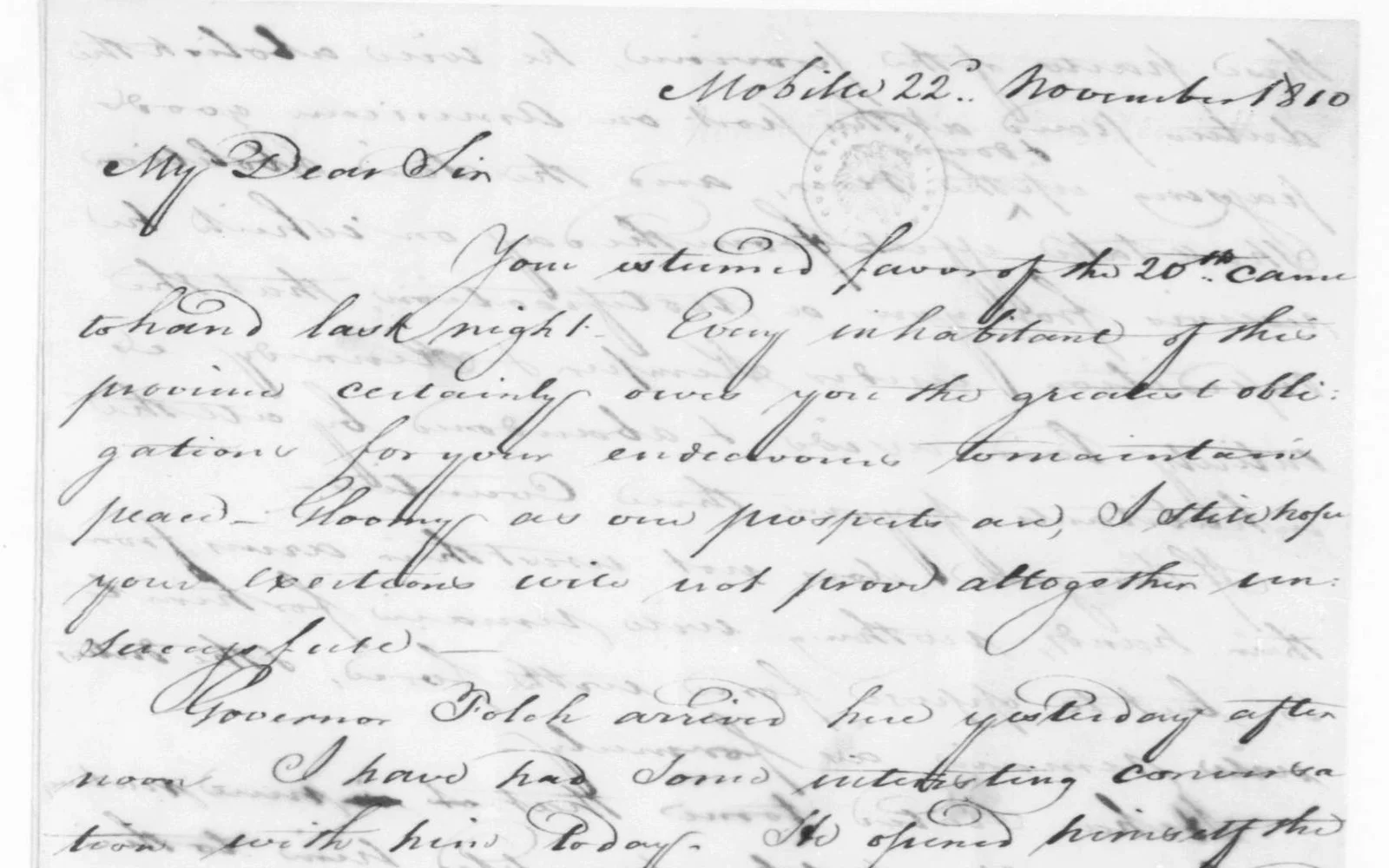
Late in November 1810, a messenger left Mobile carrying a letter and orders to wait for an answer.
Related: Ryder v. Innerarity and a Mobile land dispute
The record
The writer was James Innerarity, a Mobile merchant. The recipient was Harry Toulmin, the federal judge for the American settlements up the river. And the message, Innerarity wrote, came from the Spanish governor himself. [1]
Mobile in 1810 was a Spanish town. The settlements upriver, in what was then the Mississippi Territory, belonged to the United States. Every American cargo moving up or down the river past Mobile paid a Spanish duty. That autumn, a group of armed men had organized to put an end to Spanish rule at Mobile. Innerarity's letter calls them the expedition "under Kemper & Kennedy." [1]
The letters between these two men are now held in the papers of President James Madison at the Library of Congress. They show local leaders trying, in writing, to stop a fight before it started.
The offer
Innerarity wrote on November 22. Vicente Folch, governor of Spanish West Florida, had arrived in Mobile the previous afternoon, and the two had spoken that day. [1]
Folch's proposal, as Innerarity reported it, was specific. If no help, "directly or indirectly," was given to the "agents of the Convention" in their planned attack, Folch would "abolish the duties paid at this post on American goods passing up & down the river." The abolition would take effect on the day Folch received word from Toulmin that the expedition had been "entirely laid aside, & abandoned by all the inhabitants of your three Counties." [1]
If that did not work, Folch would "oppose force with force," and the duties would stay. [1]
According to Innerarity, the governor said he was acting from "pure motives of humanity." He wanted to avoid bloodshed "between men who will probably soon become Citizens of the Same Community." [1] Innerarity added a separate note asking that his own name be kept out of it. [1]
The judge's answer
Toulmin answered the next day, November 23, on the same sheet of paper. [1]
He did not dispute that the duties were a real burden. "Much as we groan under the duties and are severely oppressed by them," he wrote, every good citizen would be willing to go to any length "under the authority of government" to be rid of them. Those words are underlined in the manuscript. [1]
But he did not think the duties were what really drove the expedition. Its leaders, he wrote, were "influenced more by a regard to personal preponderance and popularity, and the power to be acquired under a new state of things, than to any public consideration." They used "the affair of Spanish imposition, only as a pretext for their illegal combinations." [1]
There were "honest men" among the volunteers, Toulmin said, and Folch's offer would weigh with them. He considered meeting the group at its rendezvous the next day to "talk with them," adding: "Common sense may perhaps for once prevail." [1]
He would not, however, offer the governor's concession as a reward for standing down. He would drop no hint of it, he wrote, "for I feel averse to flatter treason so much as to suggest that it can ever be an auxiliary in the cause of justice." [1]
The judge's position was that the law was the right way to end an unjust tax. An armed private expedition was not, even if it happened to succeed.
"Blackest mourning"
Two days after his first letter, on November 24, Innerarity wrote again, more urgently. [2]
Folch, he now said, had come round from Pensacola "with the view of making arrangements for putting the Country under the protection of the U.S." Innerarity feared those plans could be ruined "by the rashness of the adventurers, or by cold cautious counsels on the part of the American officer." He asked Toulmin to press Col. Sparks, the American commander, to act and prevent "an useless effusion of blood." [2] The letter records Innerarity's understanding of the governor's intentions. It does not establish what Folch actually planned. [2]
"It depends on yourself and Col. Sparks," Innerarity wrote, "whether we shall pay for the privilege of Americans with our fortunes, with our lives, whether we shall hail the Seventeen Stars with exulting Joy or blackest mourning." [2]
The letter closes on a personal note. Innerarity hoped Capt. Gaines was coming downriver, because then he could finally entrust his wife and child to him. They had been "detained here so long between fears & hopes," he wrote, that he thought it dangerous to send them upriver without protection. [2]
What came next
The letters do not tell us how the story ended, and the archive does not claim to. The broader history is well established. The expedition did not take Mobile. The town stayed under Spanish control until American troops occupied it in 1813. [3]
The letters capture a moment before that outcome was known. A Spanish governor offered to give up revenue to avoid a fight. A merchant asked to keep his name secret while carrying the offer. And a federal judge, sympathetic to the complaint, refused to treat the threat of violence as a way to win the argument.
The Innerarity name will be familiar to readers of our story on Ryder v. Innerarity, the 1833 Alabama Supreme Court case over a Mobile lot first granted under Spanish rule.
About the reporting
This story is based on two manuscript letters, with Toulmin's reply, in the James Madison Papers at the Library of Congress. Digital copies and AI-assisted transcriptions are preserved in Crypt of Echoes. Key passages were compared with the scans during publication review; the full transcriptions have not been independently proofread by a person. Uncertain readings, including the name of the rendezvous, are marked in the archive. The governor's offer is reported secondhand, through Innerarity. The letters do not show whether it was carried out. The later American occupation is background from the additional history source listed below.
Sources & archive records
- James Innerarity to Harry Toulmin, November 22, 1810, with reply of November 23
Innerarity, James, to Harry Toulmin, November 22, 1810, with note by Harry Toulmin dated November 23, 1810. James Madison Papers, Series 1, reel 12, Library of Congress, Manuscript Division. mjm016106; mjm.12_0951_0954. https://www.loc.gov/item/mjm016106/ (accessed 30 September 2026).
- James Innerarity to Harry Toulmin, November 24, 1810
James Innerarity to Harry Toulmin, November 24, 1810. Library of Congress, Manuscript Division, James Madison Papers. mjm016109; mjm.12_0955_0956; Series 1, General Correspondence; microfilm reel 12.
- Mobile, Alabama — Thomas Jefferson’s Monticello
Background on the disputed Mobile boundary and the American occupation in 1813; separate from the archived letters.
Keep reading
View all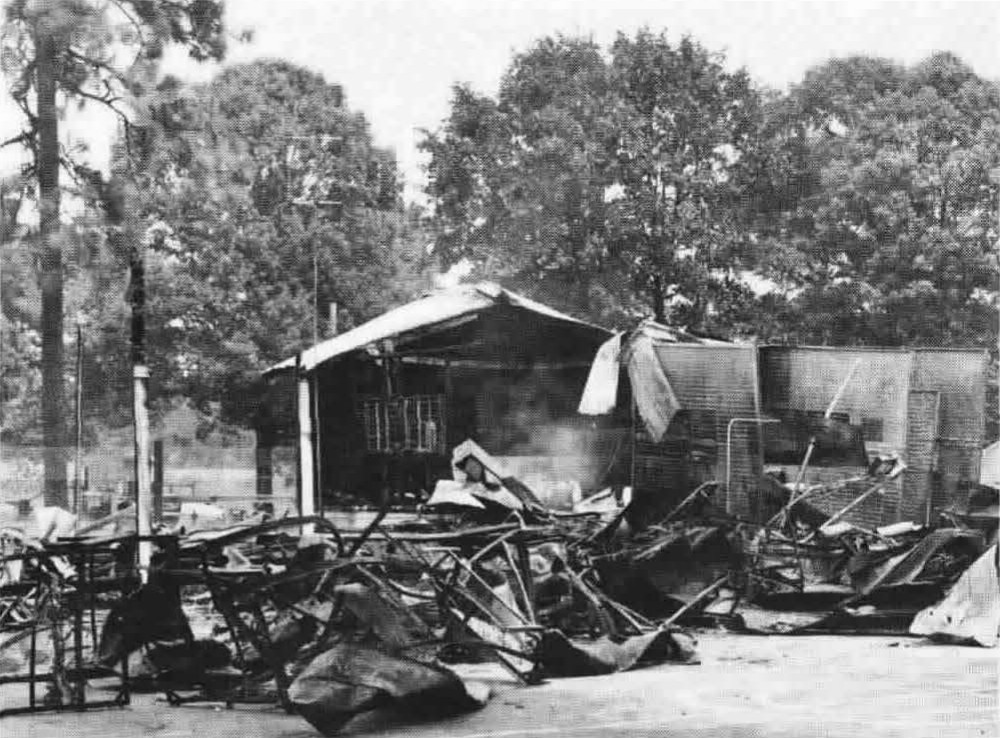
Six Minutes or Nine: What Investigators Said About the Road Camp 12 Fire
Two days after the Berrydale fire, a coroner's jury blamed three prisoners who died in it and found no neglect by the guards. The newspaper reports, official records and later accounts preserved since then do not all agree with one another.
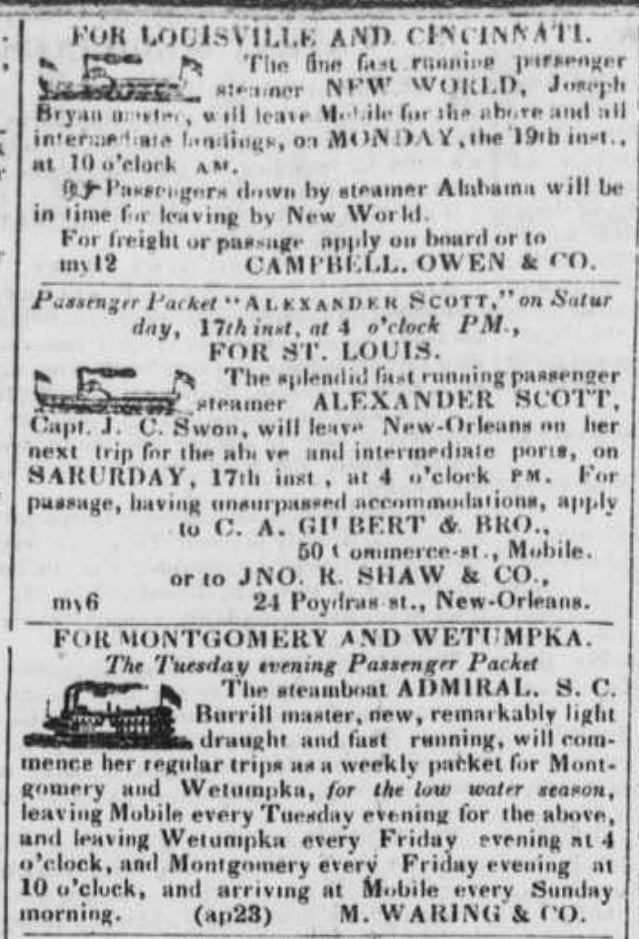
Leaving Mobile, May 1845: Three Steamboats and the Promises They Made
A single newspaper column of passenger notices shows how Mobile travelled in 1845: by published schedule, by the river's water level, and through agents on Commerce Street.
Road Camp 12: The Berrydale Fire That Killed 38 Prisoners
On a Sunday night in 1967, fire swept through a wooden prison barracks in the Florida Panhandle. Fifty-one men were inside. Only thirteen survived.