
$92 Million Promised, $2 Million Measured: The Oriskany's First Four Years in the Records
This week Okaloosa County sank the SS United States off Destin, pointing to the economic payoff of the USS Oriskany reef off Pensacola. Public records from the Oriskany's first four years, 2006 to 2010, show a first-year boost of about $2 million and no lasting rise in hotel stays.
On Wednesday, Nov. 11, the former ocean liner SS United States was sunk about 25 miles southwest of Destin to become an artificial reef. The project cost $13.5 million, according to news reports. [9]
What was promised
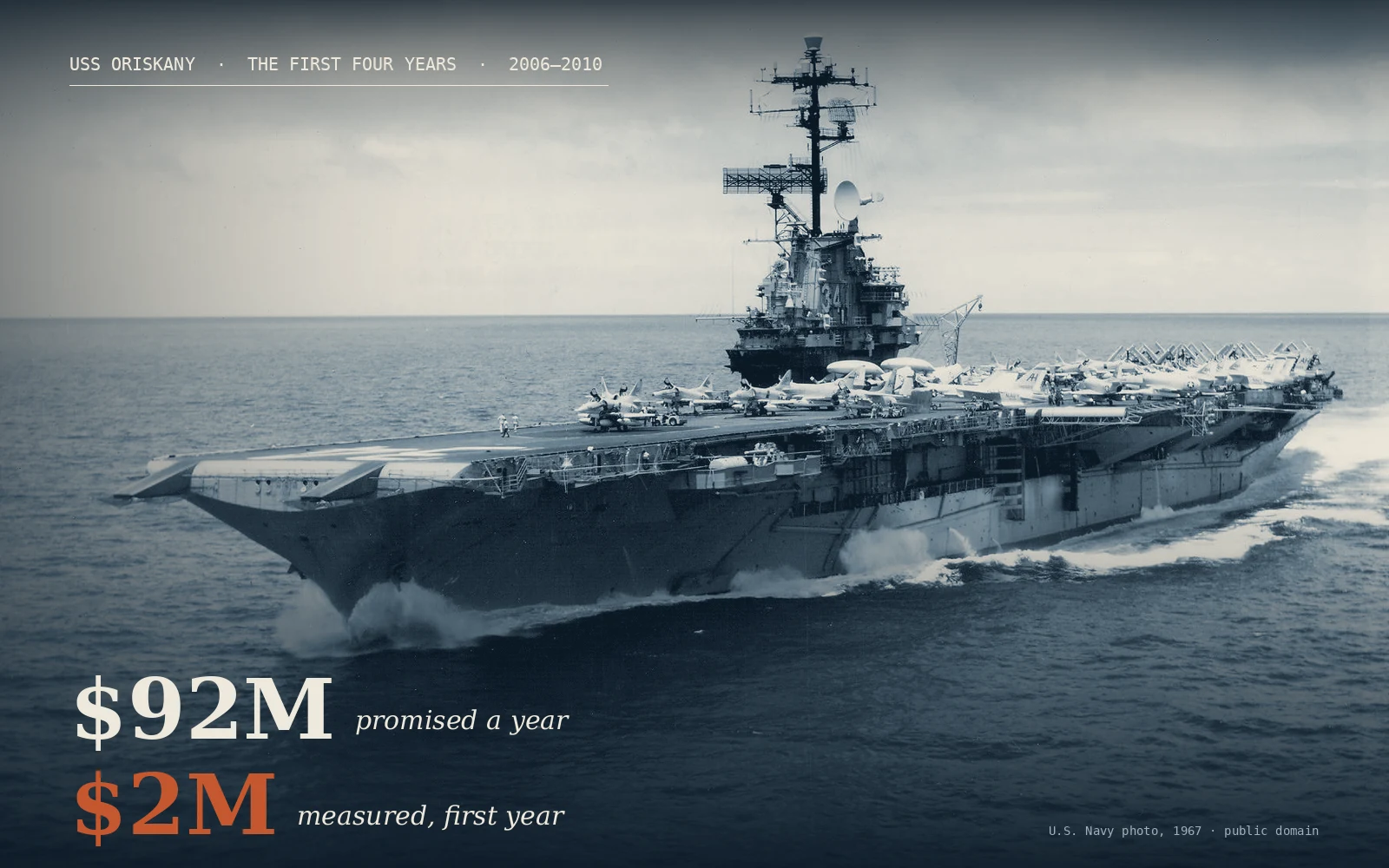
To explain what the county expects to get back, Okaloosa's natural resources chief, Alex Fogg, has pointed to the reef 12 nautical miles away: the aircraft carrier USS Oriskany, sunk off Pensacola in May 2006. He cited studies showing the Oriskany generates about $3 million a year in economic impact, and said the new reef should bring “significantly more.” [10]
The Salty Rag checked the Oriskany's record. Crypt of Echoes has gathered the public records for its first four years, from the sinking on May 17, 2006, to the Deepwater Horizon oil spill on April 20, 2010, into one data view. [1] We stopped at the spill on purpose. It shut down diving and fishing, and cleanup crews filled hotels for months, so any later year would mix its effects in with the reef's.
When the Oriskany went down, officials and news reports cited a 2004 Florida State University study estimating $92 million a year in economic benefits for Escambia County from an artificial reef. Escambia County's own pitch for the ship used $92 million as the value of all of the area's existing reefs combined, and said the Oriskany “could more than double that amount.” [2]
Nobody measured the reef's impact again.
What was measured
One study measured the reef's first year. The University of West Florida's Haas Center found that dive trips leaving from Escambia County produced $1.2 million in spending in the year after the sinking. It estimated that grew to $2 million in total economic impact as the money moved through the local economy, along with 37 jobs and $740,000 in local income. Counting trips that left from Baldwin County, Alabama, the totals were $3.6 million and 67 jobs. [3]
That study's trip count came from the area's dive shops: 4,209 charter trips to the wreck from May 2006 to May 2007. Its authors note that “no formal records are kept” of total dive trips. A second UWF study surveyed divers, using 127 survey answers drawn from one Pensacola shop's liability release forms. [4]
Nobody measured the reef's impact again. The 4,209 figure was a one-year count, but later fact sheets repeat it as a yearly number.
The hotel tax
If the reef had brought in visitors who stayed the night, Escambia's hotel tax would show it. The rate was 4 percent throughout these years, so collections track hotel spending directly. [5]
Collections grew in the reef's first two full years. Before Hurricane Ivan, the county's hotel spending had been growing about 5.6 percent a year. Every year from 2006 to 2009 came in 1 to 10 percent below where that trend was heading. [1][6]
The measured $2 million impact is less than 2 percent of the $131.5 million in hotel rent taxed in fiscal 2007. An effect that size would not stand out in the county's hotel tax even if all of it went to hotel rooms.
| Fiscal year | Hotel tax collected | Change |
|---|---|---|
| 2005 (Hurricane Ivan year) | $4,135,528 | −13.3% |
| 2006 (ship sunk in May) | $4,869,943 | +17.8% |
| 2007 | $5,260,218 | +8.0% |
| 2008 | $5,532,834 | +5.2% |
| 2009 | $5,332,852 | −3.6% |
Dive businesses
Doug Hammock, who runs the H2O Below dive charter, told WUWF in 2015 that he had made his living taking divers to the Oriskany since 2006. He said there must have been 25 boats running to the wreck in its first year. [11]
Census Bureau counts don't show that growth in Escambia. The county had four charter-boat businesses with paid staff in 2005 and two each year from 2007 to 2009. Okaloosa County, home to Destin's fleet, had about 30. [1] A year after the sinking, a Pensacola charter owner told the Pensacola News Journal that most of his Oriskany divers stayed in Destin and drove over for the day. [14]
In September 2008, Hurricane Gustav pushed the wreck deeper, putting its flight deck beyond safe reach for recreational divers. Scuba Shack co-owner Eilene Beard told the Associated Press that business tapered off afterward. [13] By 2015, Hammock said his headcount was down at least 60 percent from the reef's first four years. He attributed the drop to the oil spill, the recession and fuel costs. [11] The Scuba Shack, Pensacola's oldest dive shop and the source of the UWF survey's divers, closed in 2021 when its owners retired.
Fishing
Red snapper made up 73 percent of the fish state and county biologists sampled at the wreck. [7] In 2008, federal regulators cut the Gulf's recreational red snapper season from 194 days to 65 and its bag limit from four fish to two. The Oriskany is in federal waters. [1]
The same sampling found PCB levels in Oriskany red snapper rose from an average of 2.36 parts per billion before the sinking to 54 parts per billion after. In 2008, the Oriskany's snapper averaged 55.22 ppb, against 7.6 ppb at a nearby control reef. Through November 2009, 33 percent of fish sampled at the wreck were above the EPA's 20 ppb screening level and 21 percent were above the Florida Department of Health's 50 ppb advisory level. [7][8]
Those levels did not last. The Florida Fish and Wildlife Conservation Commission reported that average PCB levels in Oriskany red snapper fell below the state level by April 2009 and below the EPA level from late 2009 on. No fish consumption advisory was issued. [7]
The wider economy
According to the U.S. Bureau of Economic Analysis, Escambia's economic output grew 5.8 percent in 2006, slower than Florida's 6.4 percent. Jobs grew 2.5 percent, against 3.1 percent statewide. One sector stood out: output in arts, entertainment and recreation rose 20 percent that year. That category also includes attractions, golf courses and gyms. [1]
What the records do not show
The available records do not say how many Oriskany divers were local residents. The full 2007 Haas Center report should have that breakdown, but it is not online. They also do not break hotel tax down by area for these years, give charter trip counts after the first year, or show what Escambia County spent on the project. Those records would take public records requests, which are listed on the Crypt of Echoes data view. [1]
The same questions apply to the SS United States. Its top deck is about 60 feet below the surface, within reach of beginning divers, unlike the Oriskany's deeper flight deck. [9] Visit Pensacola, which is funded by Escambia's hotel tax, agreed to help pay for the new reef. [12]
About the reporting
This story is based on public records preserved in Crypt of Echoes and compiled in its data view, The Oriskany's First Four Years. Hotel tax figures are Escambia County's audited collections. The trend comparison and the 2 percent figure are The Salty Rag's own arithmetic from those records. Statements by Doug Hammock, Alex Fogg and dive shop owners come from WUWF, Get the Coast, the Associated Press and the Pensacola News Journal.
Sources & archive records
- The Oriskany's First Four Years — data view (May 2006–April 2010)
The Crypt of Echoes data view compiling the records behind this story, with the open public-records requests.
- Escambia County artificial-reef application materials and the 2004 FSU $92 million estimate
As quoted in the county's application materials and a 2006 Navy NewsStand release. The originals are not in the archive yet.
- The economic benefits associated with Florida's artificial reefs (UF/IFAS FE649)
UF/IFAS Extension FE649 (revised 2021), summarizing the Haas Center's 2007 Oriskany study.
- Diving Demand for Large-Ship Artificial Reefs (Morgan, Massey & Huth)
EPA working paper, 2007; the first-year dive-trip count and survey design.
- Escambia County's bed tax, 1980 to today — data view
The companion data view of Escambia's tourist development (hotel) tax.
- Escambia rate-adjusted taxable lodging, FY1993–2025 (compiled)
Compiled lodging-tax series used for the pre-Ivan trend comparison.
- Gulf States Marine Fisheries Commission minutes — Oriskany PCB sampling
Meeting minutes citing red snapper sampling and PCB results at the wreck.
- SINKEX petition to EPA, April 2012 (Table 1)
Petition table used for the before/after PCB figures.
- The Last Day of the SS United States, Nov. 11, 2026 — data view
Crypt of Echoes data view; see also Fox 13/Associated Press, “Historic SS United States to sink Wednesday off Florida coast,” Nov. 11, 2026.
- Get the Coast — the SS United States reef transformation
“The road ahead: Inside the year-long transformation of SS United States into the world's largest artificial reef,” Get the Coast.
- WUWF — A decade after Oriskany
“A Decade After Oriskany, Escambia Considers Sinking Another Warship,” WUWF, Sept. 30, 2015 (Doug Hammock).
- Pensacola News Journal — Visit Pensacola and the new reef
“Visit Pensacola sinks $1.5 million with Okaloosa County to reef SS United States,” Pensacola News Journal.
- Associated Press — Oriskany's shift endangers divers
“Oriskany's shift endangers Pensacola scuba divers,” Associated Press, Nov. 15, 2008 (Hurricane Gustav).
- Pensacola News Journal — Oriskany: One year below
“Oriskany: One year below,” Pensacola News Journal, May 2007.
Keep reading
View all
A First-Appearance Record Shows the Court Steps in the Beal Parkway Weapons Case
After the September 1 handgun report police described, a judge reviewed a sworn affidavit, found probable cause and appointed a public defender. The charging paperwork is now in the public file.

A Tripletail, a Porthole and a Coin: Charter Captain Honored for First Fish on SS United States Reef
Okaloosa County commissioners recognized a Santa Rosa Beach charter captain whose tripletail, caught the morning after the sinking, is the first fish on record from the new reef.
New Website Tracks SS United States Reef Off Destin With Live Gulf Data, Dive Logs and Games
BigUReef.com opened alongside the Nov. 11 sinking. It pairs NOAA and buoy readings with the ship's history and a public fund for a reef camera.