Dear Mr Poe: 153 Letters, Mapped and Read in the Writer's Own Words
For 150 years, much of what the public 'knew' about Edgar Allan Poe came from an enemy's memoir. The letters tell a different story. We gathered 153 of them — to and from Poe, 1829 to 1849 — placed them on a map, and made each one readable beside its original.
When Edgar Allan Poe died in Baltimore in 1849, a man named Rufus Griswold — a rival who had quietly resented him for years — wrote his obituary, then his official memoir. Griswold invented letters, doctored others, and painted Poe as a friendless, drug-addled wreck. The portrait stuck for generations, because it was in print and the counter-evidence was scattered across archives in a dozen cities. The counter-evidence, it turns out, is the correspondence itself. We gathered 153 letters to and from Poe, from 1829 to 1849, and built a way to read them in his own words and in his correspondents' — not as Griswold summarized them, but as they were actually written.
Why a Gulf Coast paper is writing about Poe
A fair question. The Salty Rag covers the Gulf Coast; Poe never set foot here. The connection is method, not geography. The same archive that preserves Fort Walton Beach's water reports and budget documents — a public, source-first archive built on the principle of keeping the original at the center — also holds this literary correspondence, and the same discipline applies to both. A city budget and a 19th-century letter are both primary sources, and both are routinely known to the public only through someone else's summary.
Poe is the clean case study for why that matters. Here is a figure whose reputation was shaped, for more than a century, by a hostile secondhand account, while the firsthand record sat in library vaults. When the firsthand record is gathered and made readable, the secondhand version loses its monopoly. That is the archive's entire argument, and Poe proves it at a scale a local water report never could.
The myth was a secondhand account. The letters are the primary source — and now you can read them yourself.
What's in the collection
The collection holds 153 letters spanning two decades, 1829 through 1849 — the whole of Poe's adult writing life, from a struggling young poet to the most famous and infamous literary man in America. Some are by Poe; many are to him. They were gathered from the institutions that hold the originals, chiefly the Boston Public Library's Digital Commonwealth and the Library of Congress, and each entry preserves its repository and a link to the holding institution's own catalog. [1]
The letters are not curiosities. They are the working documents of a literary career: pleas to editors, negotiations over payment, pitches for magazines Poe dreamed of founding, thanks and grievances to other writers, and the ordinary business of a man trying to make a living with his pen in a country that had no international copyright law to protect him from piracy.
Together they form something the Griswold memoir could never be: a record Poe did not control and his enemy did not forge, assembled from the archives that held the paper he actually touched.
The patron: letters to John P. Kennedy
The earliest thread in the collection is also one of the most human. In the mid-1830s, the Baltimore novelist and statesman John P. Kennedy pulled a young, nearly destitute Poe out of obscurity — recommending him for work and, in Poe's own later telling, quite literally feeding him. The letters from Poe to Kennedy, several of them preserved here from 1834 and 1835, are the record of that rescue and the gratitude that followed. [2]
Read in sequence, they show a writer at his lowest and most dependent, writing with a formality that barely contains the desperation underneath. They are the opposite of the sneering, self-destructive Poe of the Griswold legend — a man asking for help, receiving it, and saying so plainly. The archive preserves the images of the originals alongside the transcriptions, so the reader can see the handwriting tighten and loosen with the circumstances.
The correspondents who answer back
Because the collection includes letters to Poe as well as from him, it captures both sides of relationships that the standard biographies describe only from the outside. The humorist and lawyer Frederick William Thomas writes from Washington with gossip, politics, and — in one much-quoted 1841 letter — unreserved praise for 'The Murders in the Rue Morgue,' calling it the most ingenious thing of its kind on record. The English poet Richard Henry Horne writes from Kentish Town in London about the literary feuds swirling around his own work. The magazine editor Nathaniel Parker Willis writes with the breezy, worldly advice of a man who has survived the New York press.
These are not footnotes; they are the ambient reality of Poe's professional life, and they are legible here in the correspondents' own hands. A biography tells you F. W. Thomas admired Poe. The letter lets you watch him say it, in his own loose, sprawling script, and then wander off into a complaint about a stolen coat with a hundred and ten dollars in the pocket.
The enemy, in his own file
The collection does not flinch from Griswold. Letters involving Rufus Griswold are in it too, because an honest archive does not curate its villains out of the record. A reader can trace the correspondence that Griswold would later twist, and weigh his posthumous memoir against the paper trail it claimed to summarize.
This is the archive's method at its sharpest. It does not tell you Griswold lied; it gives you the letters and lets you check. A preserved source establishes what was recorded, not automatically whether a later account of it was true — and in Poe's case, the gap between the record and the legend is the whole point.
The copyright war behind the poverty
To understand why so many of Poe's letters are about money, you have to understand the economic trap he worked inside. In Poe's lifetime, the United States had no international copyright law. An American publisher could reprint a popular British novel for free rather than pay an American author for an original one, which meant native writers were competing against a flood of unpaid foreign material. The result was that even the most celebrated American author of his generation could not reliably earn a living.
The letters are the ground-level record of that war. They show Poe negotiating a few dollars a page, chasing payments that arrived late or not at all, and returning again and again to a single obsession: founding his own magazine, a publication he would control, where the economics might finally work in a writer's favor. He never managed it. The correspondence preserves the pitches, the near-misses, and the backers who wavered — the paper trail of a dream that stayed just out of reach.
This is context that a single famous letter cannot supply but that a collection can. Read across two decades, the financial thread is not evidence of a dissolute character, as Griswold implied. It is evidence of a structural problem that broke better-funded men than Poe.
The archives that kept the paper
The letters survive because institutions chose to keep them. The bulk of this collection is drawn from the Boston Public Library's holdings, digitized through Digital Commonwealth, with additional material from the Library of Congress and other repositories. Each entry in the collection names the holding institution and links to that institution's own catalog record, so the chain of custody from the original paper to the screen is never hidden. [4]
That transparency is not a formality. The entire value of a primary-source archive rests on a reader's ability to verify that the document is what it claims to be, held where it claims to be held. A transcription you cannot trace is a rumor with footnotes. A transcription that links to the Boston Public Library's own scan of the original is something you can check — and the collection is built so you always can.
Preserving the provenance also honors the libraries' work. These documents were rescued, catalogued and digitized by archivists over many years. Gathering them into one readable view does not replace that labor; it points back to it, and sends readers to the institutions that did it.
Reading the hand
There is a last barrier between a modern reader and a nineteenth-century letter: the handwriting. Some of these hands are clear and almost modern; others are cramped, cross-written to save paper, or faded by nearly two centuries. The collection pairs each letter with a transcription so the words are legible and searchable, while keeping the preserved images beside them for anyone who wants to read the original script.
Where a word is genuinely uncertain — an ink blot, a torn edge, a crossed-out false start — the transcription marks the doubt rather than inventing a confident reading. That is the difference between a transcription and a guess, and it is the standard scholarly editions hold themselves to. It is also, not incidentally, the same discipline the archive applies to a smudged line in a 1944 city-council minute book. The subject changes; the method does not.
Reading the letters on a map
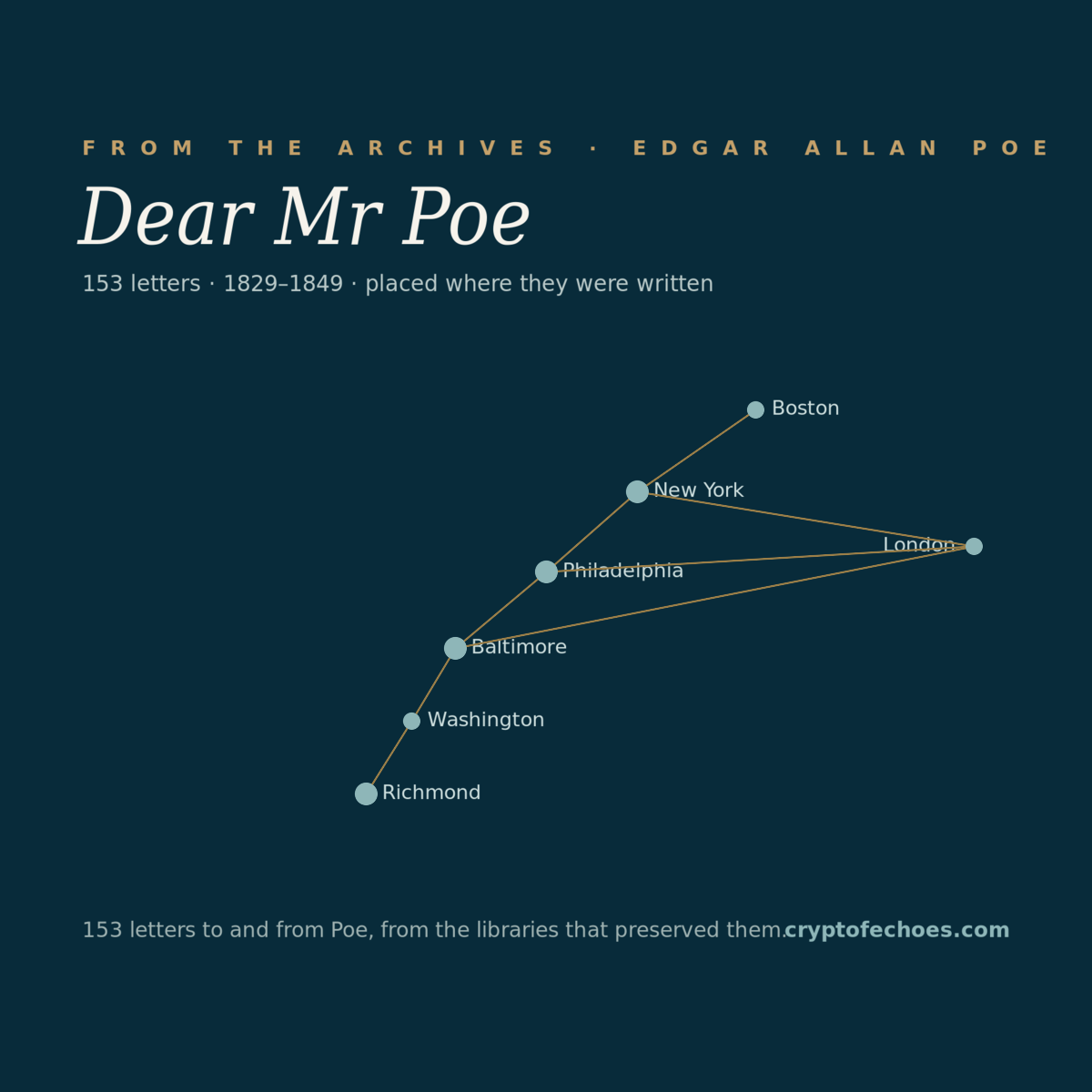
The interactive view — Dear Mr Poe — does something a printed edition cannot: it places the letters in space as well as time. Poe's life was a restless circuit of cities — Baltimore, Richmond, Philadelphia, New York — and his correspondents reached him from across the country and across the Atlantic. The view maps where each letter was written and where Poe was living when it arrived, so the geography of a literary career becomes visible: the pull toward the northern magazine capitals, the returns to the South, the single threads stretching to London. [3]
You can filter to only the letters Poe wrote, or only those he received; move through them year by year from 1829 to 1849; and open any one of them to read the transcription beside the preserved images of the original, with a link to the holding library's catalog. The map is not decoration. It is a finding aid for a correspondence that was always, fundamentally, about distance — a writer trying to be read in cities he could not afford to live in.
Why primary sources win
The Poe story is the most dramatic example of a problem the archive exists to solve, but it is not a special case. Almost everything the public 'knows' about any subject — a writer, a city budget, a prison fire — arrives pre-chewed, through a summary written by someone with a point of view. Sometimes the summarizer is careful. Sometimes the summarizer is Rufus Griswold. The reader usually cannot tell which, because the sources are out of reach.
Gathering the sources and making them readable does not settle every question — scholars still argue about dates, attributions and disputed readings, and the archive marks those uncertainties rather than papering over them. But it moves the argument onto honest ground. You are no longer choosing between competing summaries. You are reading the letter.
There is a particular satisfaction in this for a figure like Poe, whose work so often turned on the gap between appearance and truth — the detective stories that insisted the evidence, read carefully, would yield the answer; the tales of narrators whose accounts cannot be trusted. He spent a career teaching readers to look past the convenient version to the thing itself. It would have appealed to him, one suspects, that the final correction of his own record came not from a defender's rebuttal but from the primary documents, laid out for anyone to examine, exactly as his own detective would have insisted.
Explore the collection at cryptofechoes.com/collections/poe-correspondence.
A note on what the archive claims
The collection does not claim to be every surviving Poe letter; the full corpus is larger and scattered across more institutions than any one gathering captures. It claims to be 153 of them, accurately sourced, faithfully reproduced, and placed in a context — time and place — that makes them easier to read as a whole. Transcriptions are checked against the images, and uncertain readings are marked; the originals are always one link away for anyone who wants to check the work.
That is the honest version of what a source archive offers: not the last word, but the first one — the actual document, before anyone told you what it said. For a man whose last word was written by his enemy, there may be no more fitting tribute than finally letting him speak first.
So read one. Pick a year, pick a city on the map, and open a letter — the young poet begging Kennedy for a chance, the famous critic negotiating for a few more dollars a page, the exhausted editor dreaming of the magazine he would never own. You will not find the monster Griswold built. You will find a working writer, brilliant and broke, trying to be read. The record was there the whole time. It just needed to be gathered, and opened, and believed over the man who spent a century telling you not to.
Sources & archive records
- Edgar Allan Poe correspondence — the collection (153 letters)
153 letters to and from Poe, 1829–1849, each linking the holding archive's catalog.
- Edgar Allan Poe to John P. Kennedy — November 15, 1834
Early letter to Poe's Baltimore patron; Boston Public Library / Digital Commonwealth.
- Edgar Allan Poe to John P. Kennedy — September 11, 1835
Part of the 1834–1836 Kennedy correspondence preserved in the collection.
- William Wirt to Edgar Allan Poe — May 11, 1829
The earliest letter in the collection; former U.S. Attorney General responding to the young Poe.
Keep reading
View all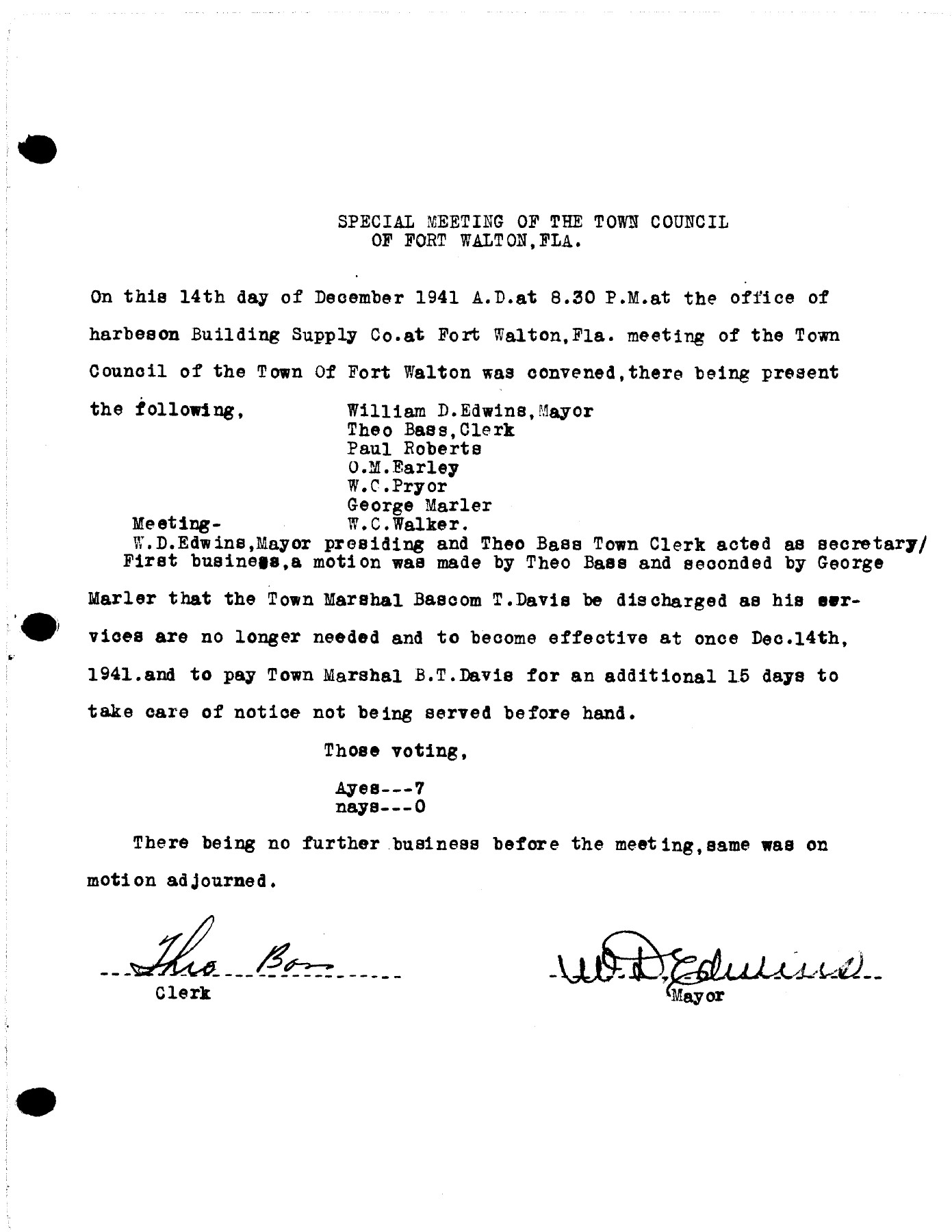
Fort Walton’s 1941 Council Dismissed Its Marshal and Approved 15 Days of Notice Pay
A one-page special-meeting record names Bascom T. Davis and explains the additional pay, but gives no detailed reason for ending his service.
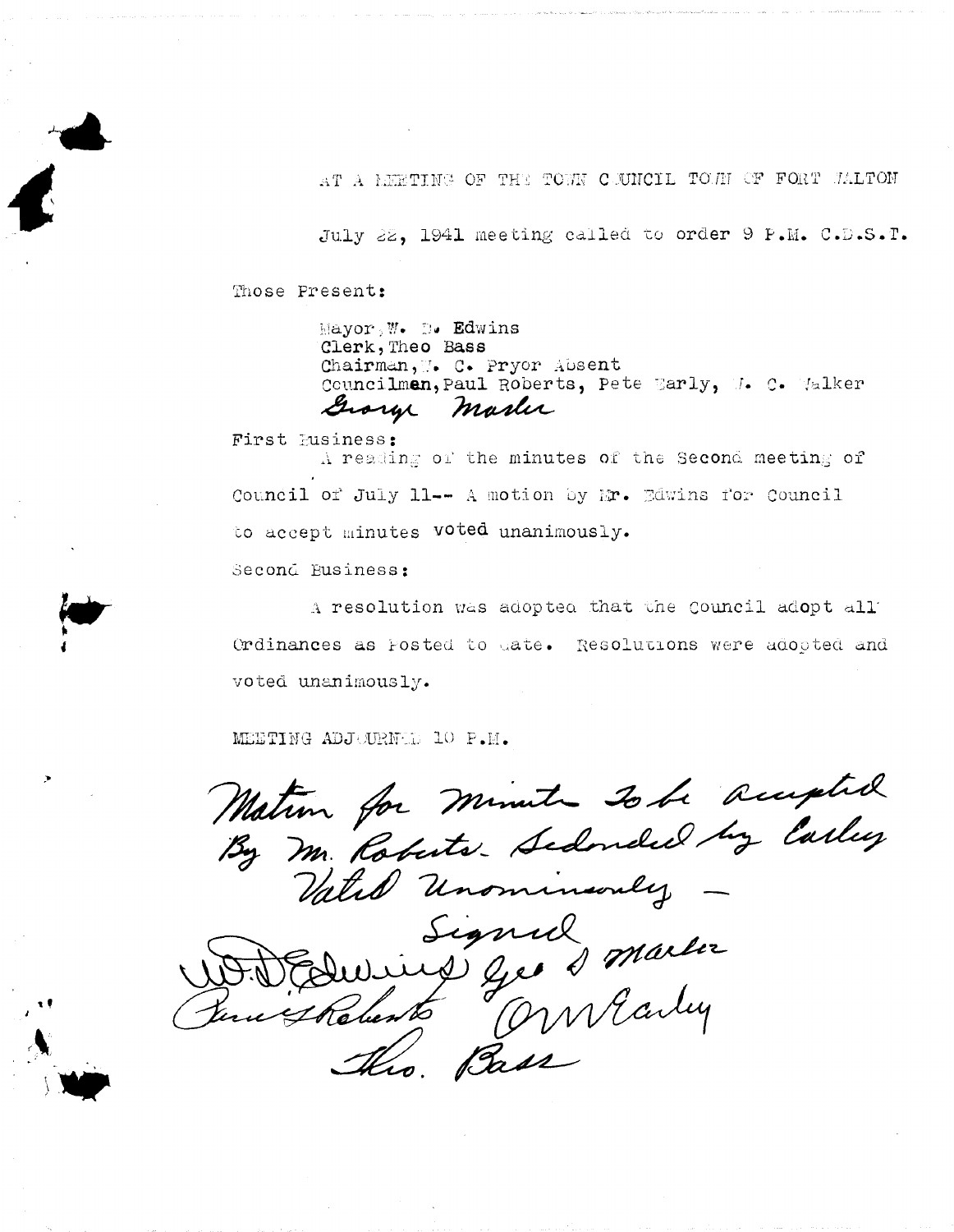
Fort Walton’s July 1941 Minutes Record a Vote to Adopt Posted Ordinances
A brief record captures a unanimous vote during an hour-long council meeting, without listing the ordinances individually.
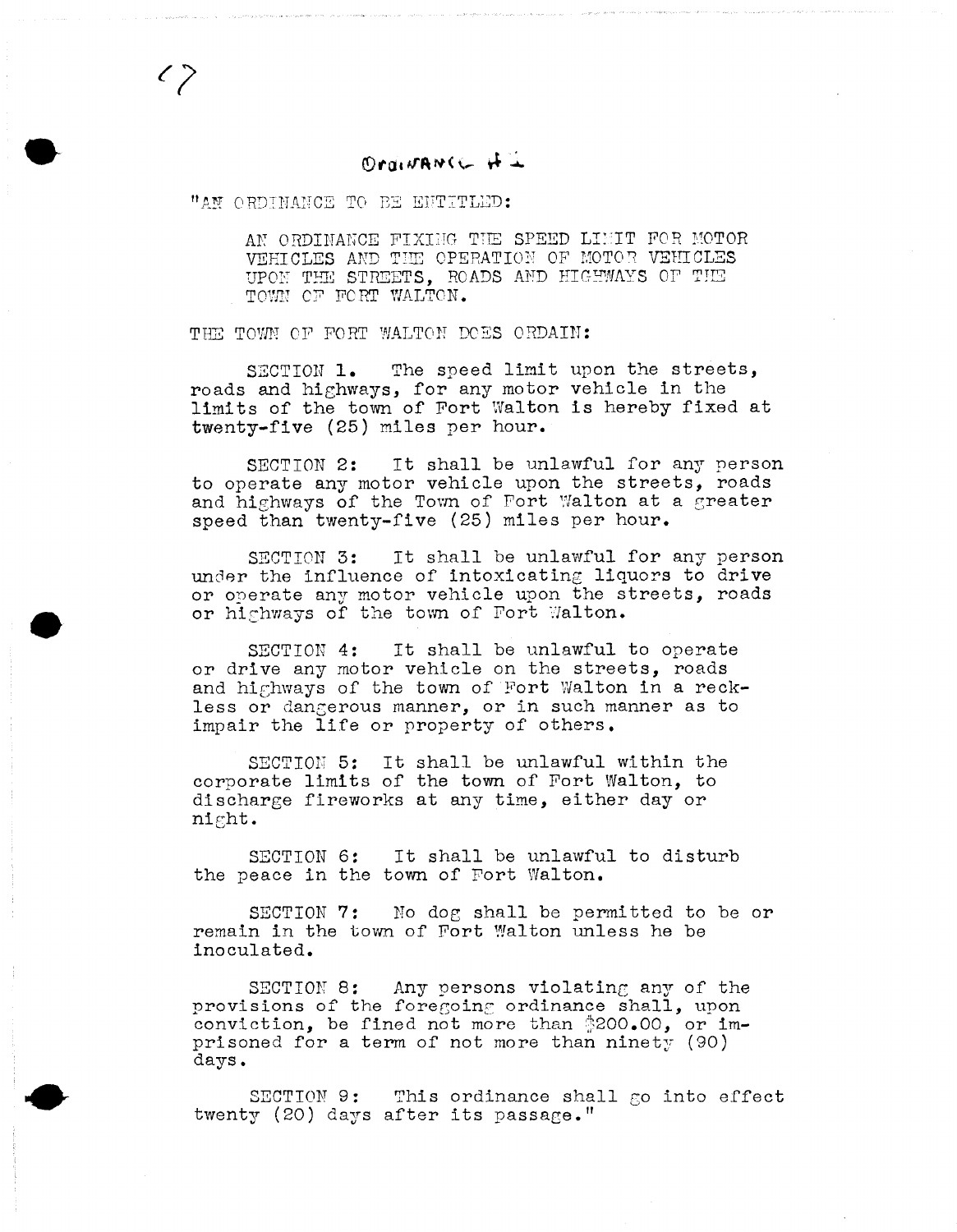
Fort Walton Chose a Marshal and Considered a 25-MPH Limit in July 1941
The July 11 minutes record a majority vote for the marshal and a first reading of rules covering traffic, fireworks and dogs.